I stopped with the French because Reasons. One of the many was having to focus on my final Swedish 3 class. This class is a requirement to take university level courses. It was a doozy of a class, culminating in writing an academic essay, all the while trying to squeeze in a literary comparative analysis and oodles of argumentative essays.
My research question was, “Has the Sami language’s status improved since it became an official minority language?” I chose this topic because I have an interest in languages, and this particular group is endangered with some being critically threatened.
Since there is no single “Sami language,” but instead many languages, I couldn’t look at it as a whole because not all are equal. I chose to compare two specific languages: Northern Sami which is experiencing a revitalization, and Pite Sami which will soon become instinct. My sister helpfully pointed out that “official” status likely points to government funding, so I pursued that link.
The map below shows the historical placement of the Sami languages. Right now, Northern Sami is spread over the top of the continent, well into Region 2. Pite Sami is extinct in Norway, but it remains on the Swedish side, in Region 3. Click on the picture if it’s too small to read.
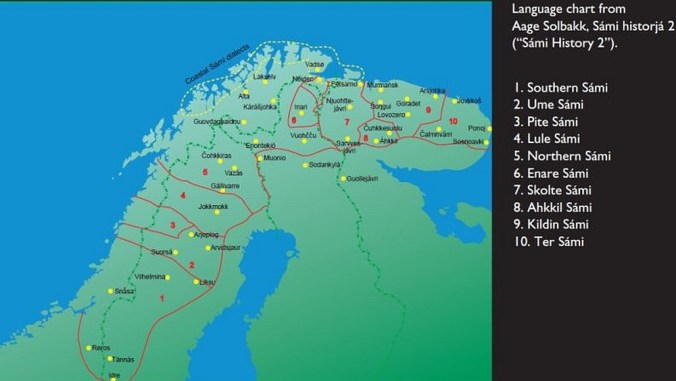
There are several factors as to why Northern Sami has been more successful. First, it was a bigger group of people before the Swedish oppression began. The people were later forced to move southwards which effectively spread their culture and language. Smaller groups were hit harder, such as Pite Sami and Ume Sami. Northern Sami is also dominant in industrial and cultural strongholds. For example, it is spoken in the mining city Kiruna, as well as the historical Sami gathering place, Jokkmokk.
During the Swedish oppression, these cultures were nearly wiped out. The traditional, stationary set-up of Western education presents a difficult problem when applied to nomadic groups. Their migration doesn’t allow the children to sit in one place for most of the year. Yet try, the Swedes did, and through the systematic enforcement of language and cultural politics, they managed to break down the family structure and nearly wipe out the Sami languages in one generation.
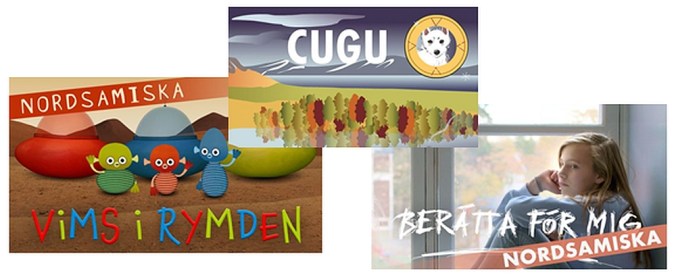
In regards to current linguistic status , the Northern Sami make more use of federal funding, especially in areas regarding children. They have invested money in preschools for Sami dominant areas, as well as a few professional-grade cartoon series with UR, a Swedish public company that broadcasts shows to the internet, television and radio. It has its own radio program as well as subtitles for news broadcasts. It is taught in two major universities in Umeå and Uppsala. The number of native speakers is about 5,000 to 6,000 in Sweden and for the whole of northern Europe, 25,000 total.
What does Pite Sami have? A foreign funded archival project from a German company. There are 20 to 30 native speakers, almost all over the age of 50. There will be no revitalization efforts for them or from them. The older generation does pass their language down to their children and grandchildren, but it’s in the form of lullabies or reindeer herding jargon. The descendants do not receive consistent information regarding their native tongue, and their dominant language is Swedish.
So that answers my question. At least one is more successful than the other. Its success can be directly attributed to the use of federal funding, made available only because they are an officially recognized minority language.
But will Northern Sami really survive? 25,000 speakers sounds like a lot, but the city I live in is about 28,000. It’s not a big city. According to Mikael Vinka, a professor in Sami languages at Umeå University, children need at least 5,000 utterances a day, with each utterance containing about five words. This will help them maintain knowledge in the language until they are 10-years old. Unfortunately, it is doubtful that Northern Sami is getting this kind of attention, even if it is supported in northern preschools. I think that the requirement for federal support is based on time allotments instead of science. One scenario is that a preschool can have someone come for forty-five minutes a week to do a Sami-based activity. Then the preschool can say that they met the requirement for federal funding. That isn’t enough to help save an endangered language.
The literature I used to source this essay was very interesting. The Sami have a Council where they publish yearly information for the Swedish government, detailing how they use government funds to promote their language. On pages 11 and 12 of that document is relevant information in English.
They created a booklet that can be found online. It is a comprehensive document on their past, present and future. There was also an anthology called “More than one language: an anthology of multilingualism in northern Sweden”. It is a collection of stories from different Sami, telling stories of their lives during the oppression. It also includes stories those that belong to another minority language, Meänkieli.
It’s some good history, and if you have the time, you might want to take a look into it.
 winter